

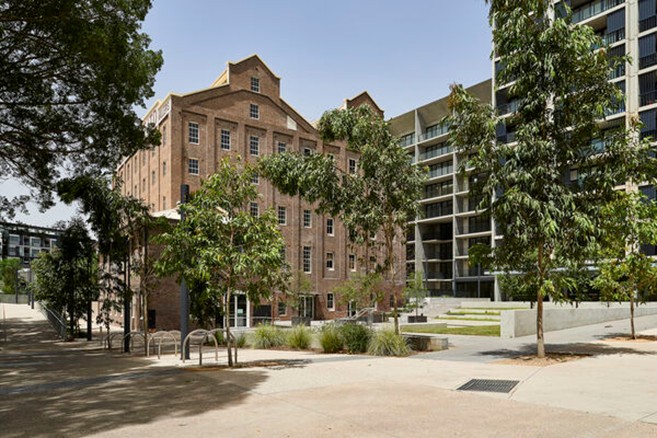
What once ground wheat now buzzes with coffee, craft, community and heritage. The Flour Mill at Summer Hill has been reborn, yet it has kept its soul intact – a new heart, built on old foundations.
Tucked into the leafy Inner West suburb of Summer Hill, the Flour Mill has a story that spans nearly a century. Originally constructed around 1922 for the milling firm Mungo Scott & Co, the site was chosen for its strategic access to the goods railway line built during World War I. Over the decades the site flourished, and in the 1950s the landmark silos were added under the stewardship of companies like Goodman Fielder and Allied Mills, cementing the mill’s role as a key local industrial hub.
Long before it became one of the Inner West’s favourite lifestyle precincts, the Flour Mill was a thriving workplace, a place of hard work, grit and the smell of freshly milled wheat. Built in the early 1920s, the Mungo Scott Flour Mill helped feed a growing city. Wheat arrived from across New South Wales, from Narromine to Wagga, where it was tested, cleaned and milled into flour that supplied local bakeries and even famed Australian biscuit producer, Arnott’s at nearby Strathfield. The site once hummed with activity, the rhythmic clatter of rollers and the whir of sifters. Workers took their lunch breaks in what is now the Little BIG House.
Local ceramicist Leonard Smith, who worked here as a miller in the late 1960s, remembers it well. He studied milling by correspondence, “all the colonies offered these kinds of courses,” he recalls, and worked his way up from bagging flour to running the rollers. “It was hard, physical work,” Leonard says, “but we were proud of what we produced.” The mill’s manager at the time was Jack Walsh, and the operation was owned by the famously frugal Sir John Cadwallader, head of the Bank of NSW. “He’d turn up in his pinstripe suit,” Leonard laughs, “but the soles of his shoes were worn thin.”
It was hard, physical work, but we were proud of what we produced. The mill was the heart of the place.
Leonard Smith, former miller and local ceramicist
Leonard remembers the Smut House, where wheat was dampened and left to soften before milling, and the “rats as big as cats” that prowled the site. The bags of flour, many beautifully printed for export to the Pacific Islands, were stacked by hand, three-bushel loads at a time.
By 2009 milling operations had ceased, and the expansive site stood ready for reinvention. What followed was a thoughtful urban renewal, a careful reimagining of the Flour Mill into a vibrant mixed-use precinct. Developer EG Funds Management commissioned the award-winning design firm Hassell Studio to transform the 2.4-hectare site into something new yet firmly rooted in its past.
Architects and developers worked to preserve the site’s distinctive silos and laneways, blending heritage with new life. Today, the Flour Mill is home to around 360 apartments and terrace homes, along with cafés, restaurants, a gift shop and art studio set among heritage laneways, plazas and green spaces. EG has reflected on what makes the project special, noting that balance and sensitivity to the site made all the difference. More than 30 per cent of the built floor space was retained and reimagined as heritage buildings, including the towering concrete silos, now repurposed into premium residences.
But it’s not just housing. The precinct was designed to be a genuine community hub. Architect and writer Elizabeth Farrelly describes the Flour Mill “as a small pocket of success in Sydney,” and we couldn’t agree more.
With the central Mungo Scott Plaza, landscaped green spaces and pedestrian links to the nearby light rail, locals and visitors alike gravitate here. The site retains a charming, village-like feel with small family-run businesses, cafés, weekend markets and family-friendly events. It feels like much more than a residential development, it’s a peaceful, welcoming destination in the Inner West, a shared backyard where people can relax, unwind and connect with friends and neighbours.
With the support of the NSW Government through the Office of the 24-Hour Economy, the Flour Mill continues to hum, not with machinery, but with people, ideas and creativity. From milling to making, this story continues to rise.